.png?width=239&height=25&name=Logo%20horizontal%2001%20(1).png)
On the last day of ITC Vegas, in the middle of the loudest AI room in insurance, SUPERAGENT AI CEO Vlada Lotkina and CMO Wil Salguero went live for 60 minutes with one rule: no hype and no roadmap slides. The question was simple. What are insurance agencies actually doing with AI right now, and what does it return?
This blog continues the discussion from the same topic.
If you would rather hear it, you can watch the full live recording on YouTube. If you would rather see what it looks like in your own agency, book a demo.
Almost every agency is experimenting. Very few agencies have anything running in the daily workflow. And experiments do not write premium.

The gap: individuals adopted, agencies did not
Start with what the research says, because the numbers tell the story better than any booth banner.
Liberty Mutual, 2026 Independent Agency Growth Study (via IA Magazine)
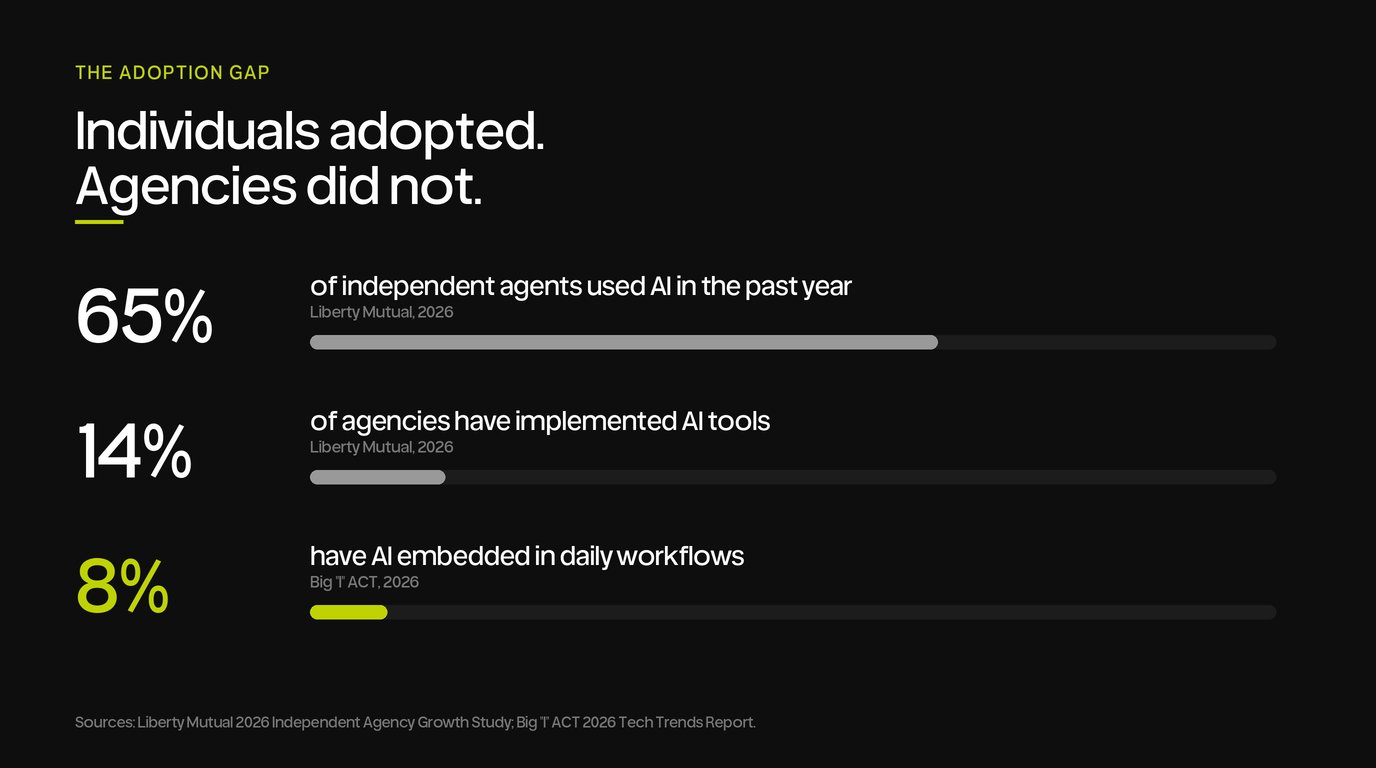
found that 65 percent of independent agents used AI at least a few times in the past year, up from 37 percent the year before.
Weekly use more than doubled, from 18 percent to 41 percent. Agents who use it report saving about four hours a week.
Now the other half of the same study: only 14 percent of agencies have actually implemented AI tools.
Big "I" ACT 2026 Tech Trends Reportputs a finer point on it. More than two-thirds of agencies plan to increase their AI use, yet only 8 percent say AI is embedded in their daily workflows, and 33 percent describe themselves as "just experimenting."Individuals adopted. Agencies did not. That gap is where this whole conversation lives.
What agencies actually do with AI today, and what is missing
According to the Liberty Mutual study, the top uses are summarizing meeting notes (44 percent), generating marketing content (43 percent), and comparing policy details (34 percent). The Big "I" ACT report found that about 45 percent of agencies use ChatGPT or another public chatbot as their main AI tool.
None of that is bad. Four hours a week is real time back. But look at what is not on the list: the phone. The lead that came in at 8 PM. The new producer who is three weeks in. The renewal that is 45 days out.
Everything on that list is back-office. The revenue line is untouched.

Why owners have not moved yet
It is not a technology problem. Only 29 percent of principals say they feel knowledgeable enough to make AI decisions, and just 22 percent of agents trust AI with business and client data (Liberty Mutual). In the Big "I" ACT report, the top concerns were data privacy and compliance (24 percent), inaccurate output (22 percent), and losing the human touch (17 percent). Only 13 percent of agencies have a formal AI policy, and 56 percent have none.
Those are reasonable worries. The barrier is that few owners have seen what a real deployment looks like, limits included. So let us do that.
Five use cases producing results in agencies right now
For each one, ask the same four questions: what is running, what does it return, what will it not do, and what do you measure in week one?
1. Inbound calls: answer every call
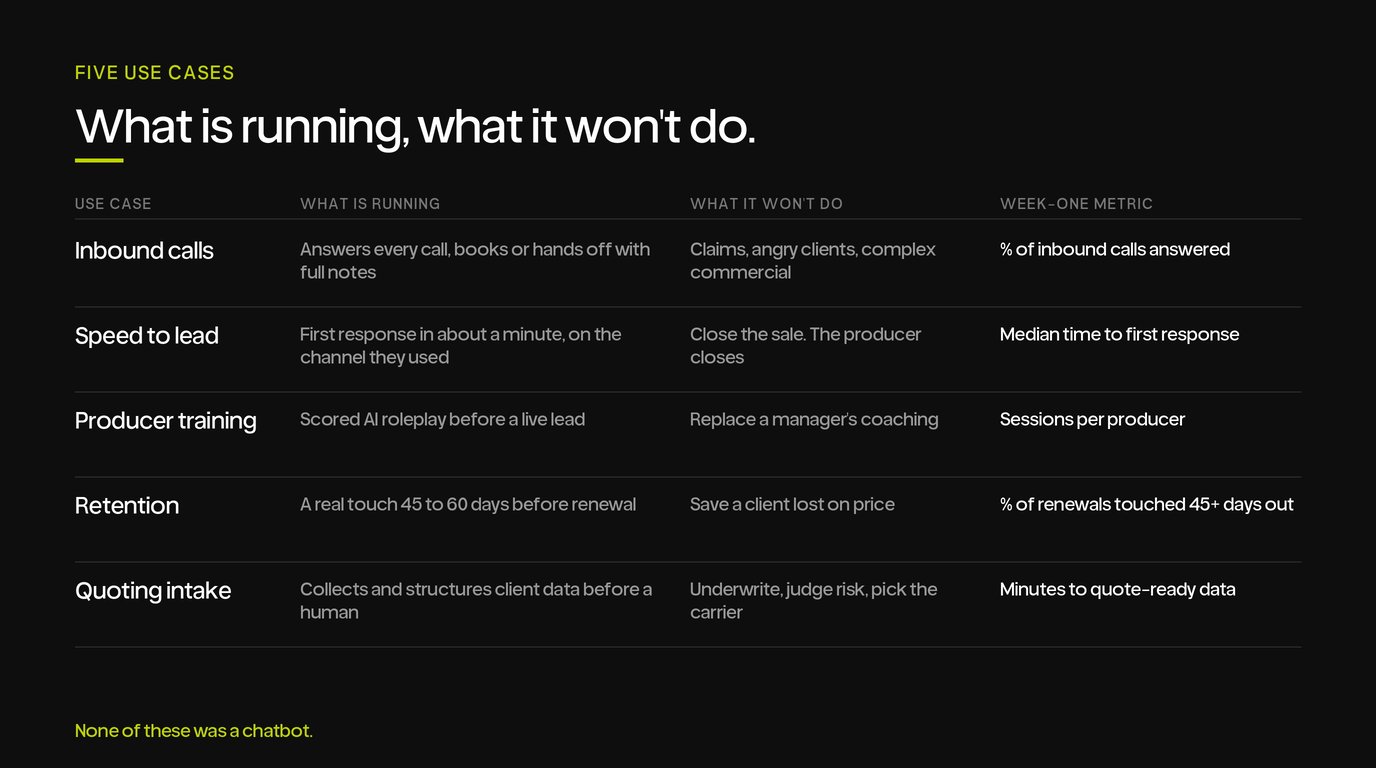
What is running. An AI voice agent picks up every inbound call, including overflow, after-hours, weekends and lunch. It qualifies the caller, captures the details or books the appointment, and hands off to a person with full notes.
What it will not do. Handle claims, angry clients, or complex commercial risks. Its job on those is to route to a human fast, not to solve them. If a vendor tells you their AI handles claims calls, walk away.
Week-one metric. The percentage of inbound calls answered, before versus now. Then the appointments booked from windows you used to miss.
How to think about cost. Compare it to a part-time CSR. Never compare it to zero.
2. Speed to lead: the first response, every time
What is running. Every inbound lead, whether web form, carrier lead, referral or chat, gets a response within about a minute, by whichever channel the prospect used. The lead is qualified and booked onto a producer's calendar.
Why it matters. The odds of qualifying a lead fall the longer you wait, and most agencies still respond the next business day.
What it will not do. Close. The producer closes. What changes is that the producer gets a booked appointment instead of a cold callback. If your producers feel replaced, it was set up wrong.
One thing to settle first. Compliance. Messaging consent, opt-outs and time-of-day rules belong in step one, not step five. Write the rules down with your own counsel before go-live.
Week-one metric. Median time to first response.
3. Producer training: practice before the first real call
What is running. AI roleplay. A new producer works through objections, quote presentations and cross-sell conversations against an AI prospect that pushes back, with the practice scored and repeatable, before they touch a live lead.
Why owners care. Most producer training is "shadow a veteran for two weeks." You would never let a pilot fly without a simulator, yet many agencies let new producers practice on customers.
What it will not do. Replace a sales manager's coaching. It makes coaching about the hard 10 percent instead of the 90 percent that is just repetition.
Week-one metric. Practice sessions completed per producer, and days to first bound policy for new hires.
4. Retention: work the book you already have
What is running. Forty-five to sixty days before renewal, every client gets a real touch. Life changes surface, like a new car, a new driver or a new house. Single-policy clients get a specific cross-sell conversation. Anything that needs a person is booked to a producer with notes.
The math. Industry retention data we see consistently shows clients with three or more policies staying at a far higher rate than single-policy clients (roughly 94 percent versus 67 percent, directionally). That gap is the most predictable revenue in an agency and the most neglected. It is also the one use case that needs zero new leads, because the list already exists and nobody has time to work it.
What it will not do. Rescue a client who already decided to leave over price. It catches the ones who leave because nobody called.
Week-one metric. The percentage of upcoming renewals touched 45 or more days out.
5. Quoting intake: data before the human
What is running. AI collects and structures the client's information, such as drivers, vehicles, property and current coverage, before a producer or CSR spends a minute on it. Clean data lands in your CRM or management system, so nobody retypes it.
What it will not do. Underwrite, judge risk, or pick the carrier. Those are human calls.
Week-one metric. Minutes from first contact to complete, quote-ready data.
This is also where AI goes wrong fastest. If your CRM is a mess, AI makes the mess faster, which brings us to the next section.

Step back and look at the five. Inbound calls, speed to lead, training, retention, intake. Notice that none of these was a chatbot.
Where AI fails in agencies (and the one-line fix for each)
This is the part people remember and share, so here it is plainly.

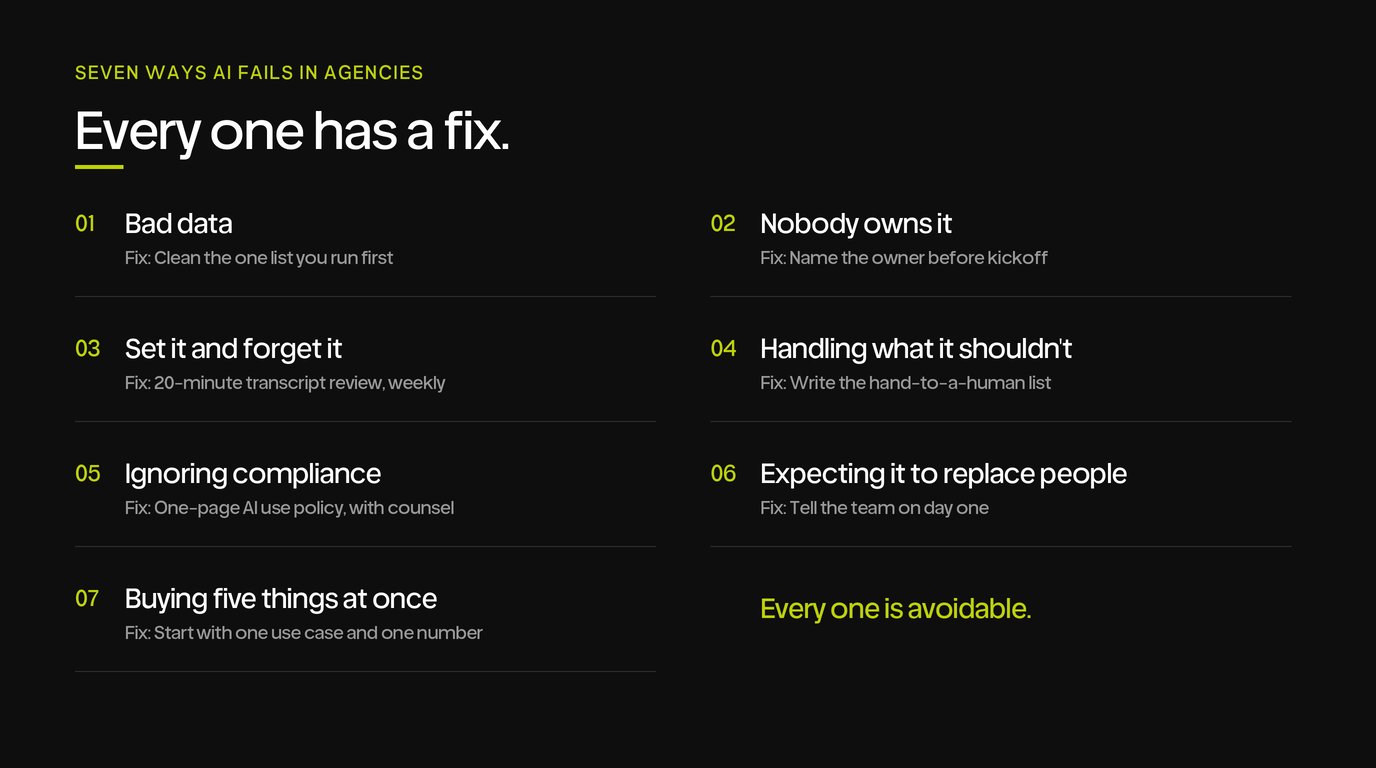
- Bad data. Duplicate clients, wrong numbers and stale policies get multiplied. Fix: clean the one list you will run first, not the whole CRM.
- Nobody owns it. "We turned it on" is not a strategy. Every deployment that works has one name and one metric. Fix: name the owner before the kickoff call.
- Set it and forget it. The first two weeks are calibration. Fix: a 20-minute transcript review every week for the first month. The agencies that cancel in month three never read a transcript in month one.
- Letting it handle what it should not. Claims, complaints, complex commercial. Fix: write the "hand to a human" list before go-live.
- Ignoring compliance. Consent, recording disclosure and data handling matter, and most agencies have no written AI policy at all. Fix: a one-page AI use policy, reviewed by your own counsel.
- Expecting it to replace people. It removes the parts of the job people dislike. Producers still close. Fix: tell your team that on day one, in those words.
- Buying five things at once. Fix: the 30-day plan below.
None of this is a reason to wait. Every one is avoidable, and avoiding them is what separates the 8 percent from the 33 percent who are still experimenting.
The 30-day plan

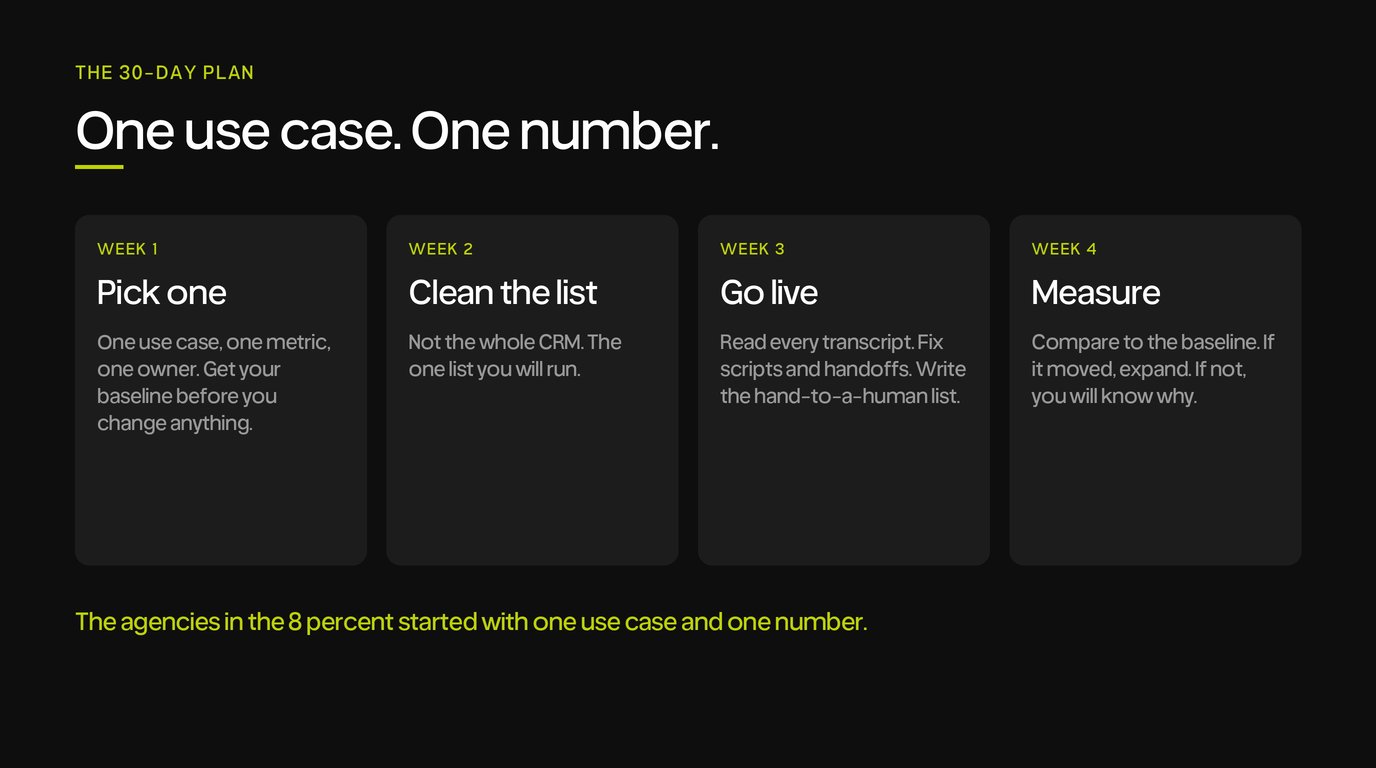
The agencies in that 8 percent did not start with five use cases. They started with one use case and one number.
- Week 1: Pick one. One use case, one metric, one owner. Get your baseline before you change anything: missed calls per week, median response time, renewals touched, ramp days, or minutes per quote.
- Week 2: Clean the list you will run. Not the whole CRM. That one list.
- Week 3: Go live and read every transcript. Fix scripts, fix handoffs, and write the "hand to a human" list if you have not.
- Week 4: Measure against the baseline. If the number moved, expand. If it did not, you will know exactly why, and it is fixable.
Thirty days from today, you can be in the 8 percent.
Questions we expect agency owners to ask
What does this cost?
Compare it to what it replaces or supplements, such as a part-time CSR or the hours your producers spend on data entry, not to zero. Pricing for SUPERAGENT is on the pricing page, and a demo will map it to your agency's volume.
Does it work with my management system or CRM?
Ask any vendor, "Which of my systems can you write to, by name?" For SUPERAGENT, the integrations today are RingCentral, AgencyZoom and HawkSoft, plus Google, Outlook, Cal.com and Calendly calendars. If a system is not on a vendor's list, assume it does not work.
Will my clients know it is AI?
Disclose it. Clear disclosure is part of using AI responsibly, and your counsel can help you word it for your state.
Is it impersonal?
Seventeen percent of agencies in the Big "I" ACT report worry about losing the human touch. The impersonal experience is the call nobody answered.
Where should a 3-person agency start versus a 25-person agency?
Both start with one use case and one metric. A three-person agency usually feels missed calls and slow lead response first. A 25-person agency often gets the fastest return from producer training and renewal work, because the volume is already there.
What about E&O and compliance exposure?
Use guardrails, disclosure, and a human in the loop on anything binding, and put it in a one-page policy. This is general information, not legal advice. Talk to your own counsel.
Pick one use case. Get your baseline. We will map it to your agency.
Book a demoWatch the full sessionSee what it looks like in your agency
Pick one use case. Get your baseline. If you would like to see how SUPERAGENT works across calls, leads, training and renewals on one platform, book a demo and we will map it to your agency. And if you missed the session, watch the full live recording

Comments