.png?width=239&height=25&name=Logo%20horizontal%2001%20(1).png)
The disconnect between “we should cross-sell more” and what actually happens
Every agency owner agrees that cross-selling is one of the highest-leverage activities they could be doing.
The math is obvious: customers who hold multiple policies with one agency retain at meaningfully higher rates, have higher lifetime value, and are cheaper to serve.
Yet across the typical P&C agency, cross-sell penetration is low. An auto-only customer in your book has, statistically, somewhere between a 1-in-3 and a 1-in-5 chance of also holding home insurance with you.
The other 70 to 80% of your auto customers have a home policy somewhere else. That gap is the largest unrealized revenue opportunity in most agencies.
.jpg?width=2752&height=1536&name=cross-sell-photo-01-you-wrote-the-car%20(1).jpg)
Here is the part that should sting. You are already paying to service those customers. You answer their calls, process their endorsements, and handle their claims. A competitor is collecting the home premium on a household you support all year.
This piece is a structured playbook for closing that gap, drawn from what we see the top-quartile agencies in our customer base actually doing differently. It is not “be more proactive.” It is a specific set of operational shifts.
The diagnostic that almost no agency runs
Before you can cross-sell well, you need to know what you have to work with. The diagnostic is one query against your AMS:
For every active personal lines customer in your book, what policies do they hold with you, and which natural cross-sell opportunities are open?
Segment the output like this, and write the counts in the right-hand column before you read any further.'
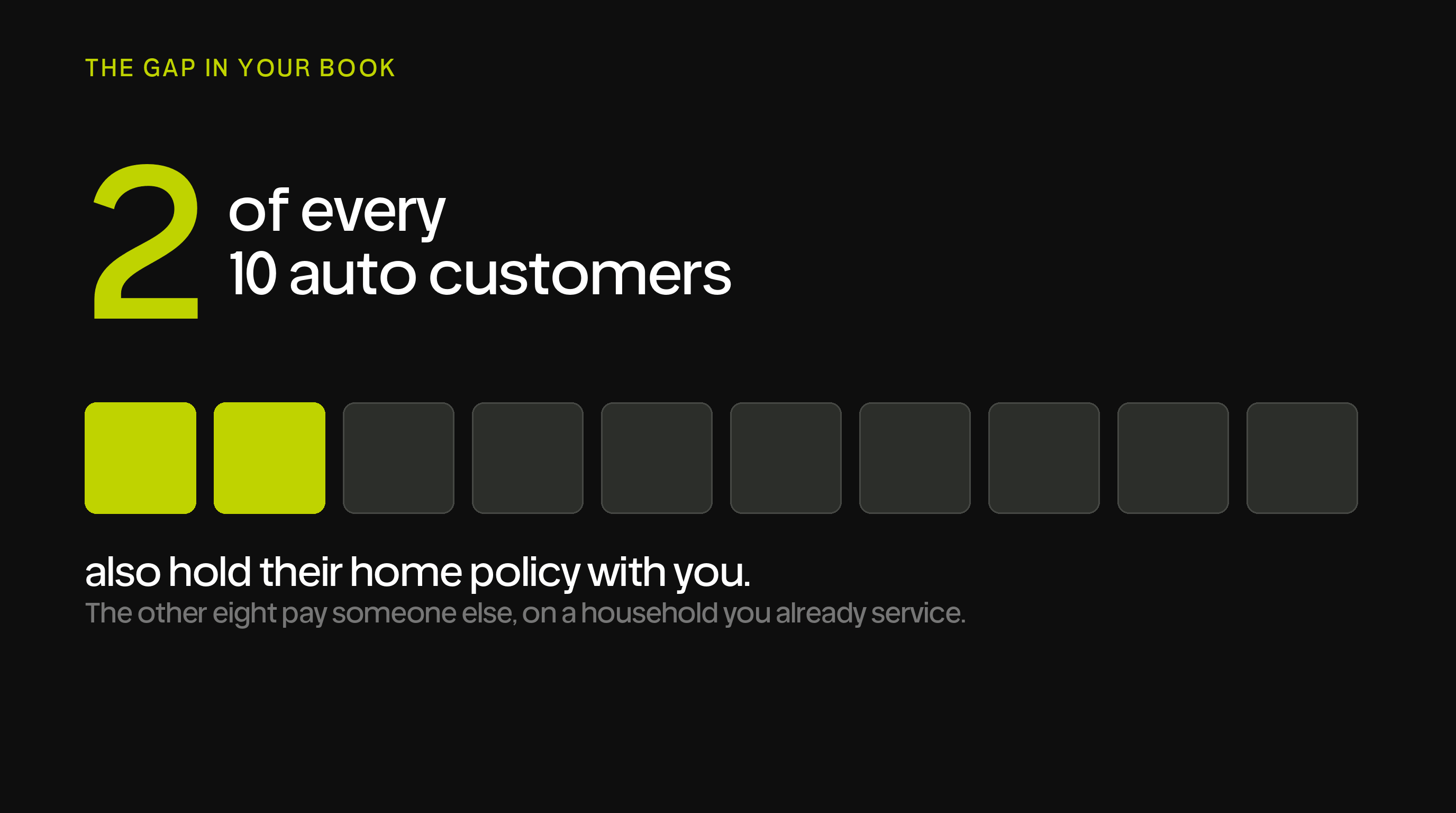
Most agencies have never run this query. They have a vague sense that “we should cross-sell more,” but they cannot tell you what the actual cross-sell-eligible universe inside their own book looks like.
If you do not have this list, that is step one. Pull it. Look at it.
Then do one more thing while you have the file open: sort the auto-only segment by tenure and by premium. Your best first calls are not the newest customers. They are the ones who have been with you three years or longer and have never been asked, because tenure is trust you have already earned and never spent.
Why cross-sell falls through the cracks
Three structural reasons cross-sell rarely happens in proportion to its value.
Reason 1: producers do not have time for proactive outreach. Producers spend their time on what is in front of them: new business calls, renewal conversations, claims issues, the urgent. Cross-sell to an existing auto-only customer is rarely urgent. It gets pushed.
Reason 2: the trigger is invisible. A customer who just had a baby, bought a house, started a side business, or had a teenage driver added to their auto policy is a high-probability cross-sell candidate. But unless someone in the agency knew about the trigger and acted on it, nothing happens. Most agencies do not have the structured data layer that surfaces these triggers automatically.
.jpg?width=2752&height=1536&name=cross-sell-photo-02-the-trigger-nobody-logged%20(1).jpg)
Reason 3: producers are uncomfortable with the conversation. Many producers, especially newer ones, feel awkward proactively suggesting additional coverage to an existing customer. They worry about being salesy with someone who trusts them. The discomfort is real and undertrained.
The agencies that crack cross-sell are the ones that solve all three: producer time, trigger visibility, and conversation comfort.
The trigger map
Reason 2 is the one most agencies could fix this quarter, because the triggers are not mysterious. They are a short, knowable list, and most of them come out of your own conversations.
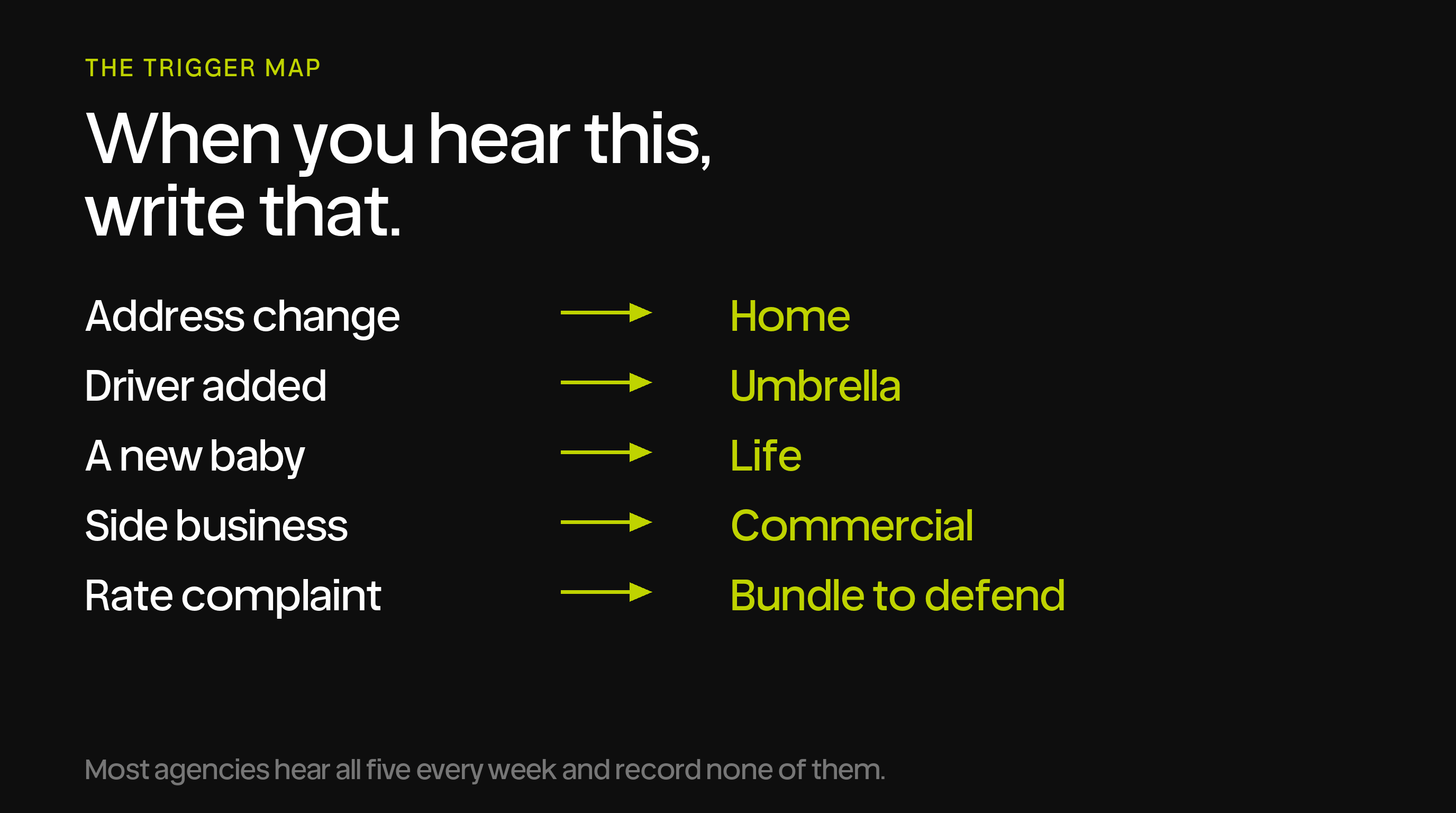
Print that. Put it where producers can see it. Even with no technology at all, an agency that works this list deliberately will beat an agency that waits to be told.
The top 1% playbook: six shifts that compound
Here is what we see the top performers doing, in order of impact.
Shift 1: make trigger detection automatic
Every customer interaction contains information that could indicate a cross-sell opportunity. A coverage change request. A life-event mention in a call. An address update that signals a home purchase. A vehicle addition.
The top agencies capture this structured information automatically rather than relying on memory. The Live Call AI Agent analyzes every call after it happens and pulls out structured fields from the conversation along with a cross-sell read: which product lines actually came up, and whether the opportunity was missed. A producer starts the day with a queue rather than a recollection.
Even without AI, a manual version of this is possible: a structured post-call notes template with required fields for life events, coverage gaps, and cross-sell triggers. The point is to capture the data systematically. A template that is actually filled in beats a sophisticated tool that nobody adopts.
.png?width=2008&height=1432&name=Frame%201000007834%20(1).png)
Shift 2: run a calendared cross-sell cadence, not a reactive one
The top agencies treat cross-sell like a renewal: it has a calendar. Auto-only customers get a coverage review touchpoint at a defined interval, typically 6 to 12 months from initial bind. The conversation is not “we want to sell you more.” It is “we want to make sure your coverage still reflects your situation.”
The cadence is the thing, not the channel. A structured sequence across call, text, and email over a couple of weeks, that stops the moment someone engages and hands them to a producer, will outperform a producer promising to get to it. In SUPERAGENT this runs as a cross-sell campaign playbook, with the outreach automated and the human stepping in for the actual conversation. However you build it, the design rule is the same: the cadence should not depend on anyone remembering.
Shift 3: train the cross-sell conversation explicitly
Most producer training programs over-index on new business and under-index on cross-sell. The conversational moves are different. New business is about discovery and trust-building from scratch. Cross-sell is about building on a relationship that already exists, which most producers find harder than they expect.
.jpg?width=2752&height=1536&name=cross-sell-photo-03-not-selling-reviewing%20(1).jpg)
The top agencies run explicit cross-sell training, auto-to-home, home-to-umbrella, and so on, as a discrete module. The Training AI Agent runs cross-sell practice against simulated customers filtered to the exact scenario, including three levels of resistance, so a producer can drill the version of the conversation they keep losing. Inside a practice session the assistant works live: it transcribes as they speak, checks off the stages of the framework as they cover them, and when the simulated customer raises an objection it surfaces your agency’s own handling guidance in the moment. This is the kind of coaching that used to require senior-producer time and therefore rarely happened.
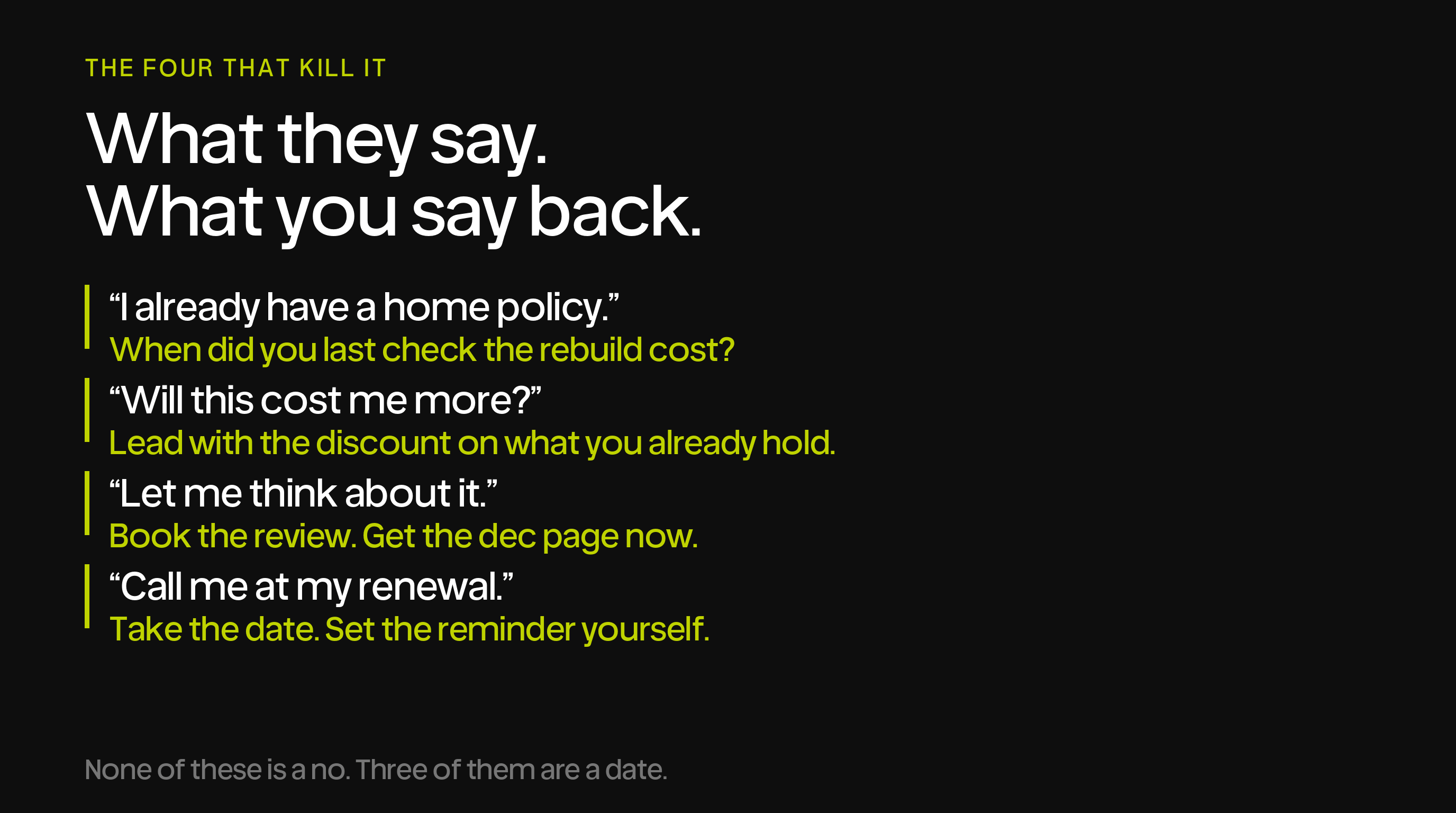
The four objections that kill cross-sell, and the move for each.
“I already have a home policy.” Not a no. The move is a review, not a quote: “Totally fine. When did you last look at the rebuild cost on it?” You are offering a second opinion, which is what they actually want.
“Is this going to cost me more?” Answer the real question, which is whether you are upselling them. Lead with the bundle discount on the policy they already hold with you, and be honest when the total goes up.
“Let me think about it.” Almost always means they cannot evaluate it yet. Do not chase. Book the review with a date attached and put the declaration page request in writing while you are still on the phone.
“I’ll call you when my renewal comes up.” Take it, and take the date. Then set the reminder yourself, because they will not.
Shift 4: tie cross-sell to renewal touchpoints
The renewal conversation is one of the highest-attention moments you have with a customer. They are looking at their premium, comparing it to alternatives, and open to a deeper conversation about coverage.
The top agencies use the renewal moment to surface cross-sell opportunities. Not aggressively. Conversationally. “While we are reviewing your auto renewal, can I check whether your home coverage is still with the same carrier? I noticed you bought the house in 2022 and the rebuild cost has likely changed.”

That is one structured conversation that touches retention and cross-sell simultaneously. The agencies that run this consistently outperform agencies that treat them as separate motions.
Shift 5: measure cross-sell by producer and by carrier
The agencies that move the number have a dashboard that tells them which producers are running cross-sell well and which are not. The variance between producers is often startling. One producer with a 22% auto-to-home cross-sell rate; another with a 7% rate, on a similar book. That gap is coachable, but only if you can see it.
Most agencies cannot, because the only record of a missed cross-sell is the absence of one, and absences do not show up in reports.
This is where post-call analysis earns its keep. Cross-sell gets read on every call and sorted into three states, which are three completely different management problems:
- The producer did not offer. A coaching problem. Fixable this week.
- The customer declined. Not a failure. A follow-up with a date on it.
- Timing was wrong. A calendar entry, not a lost deal.
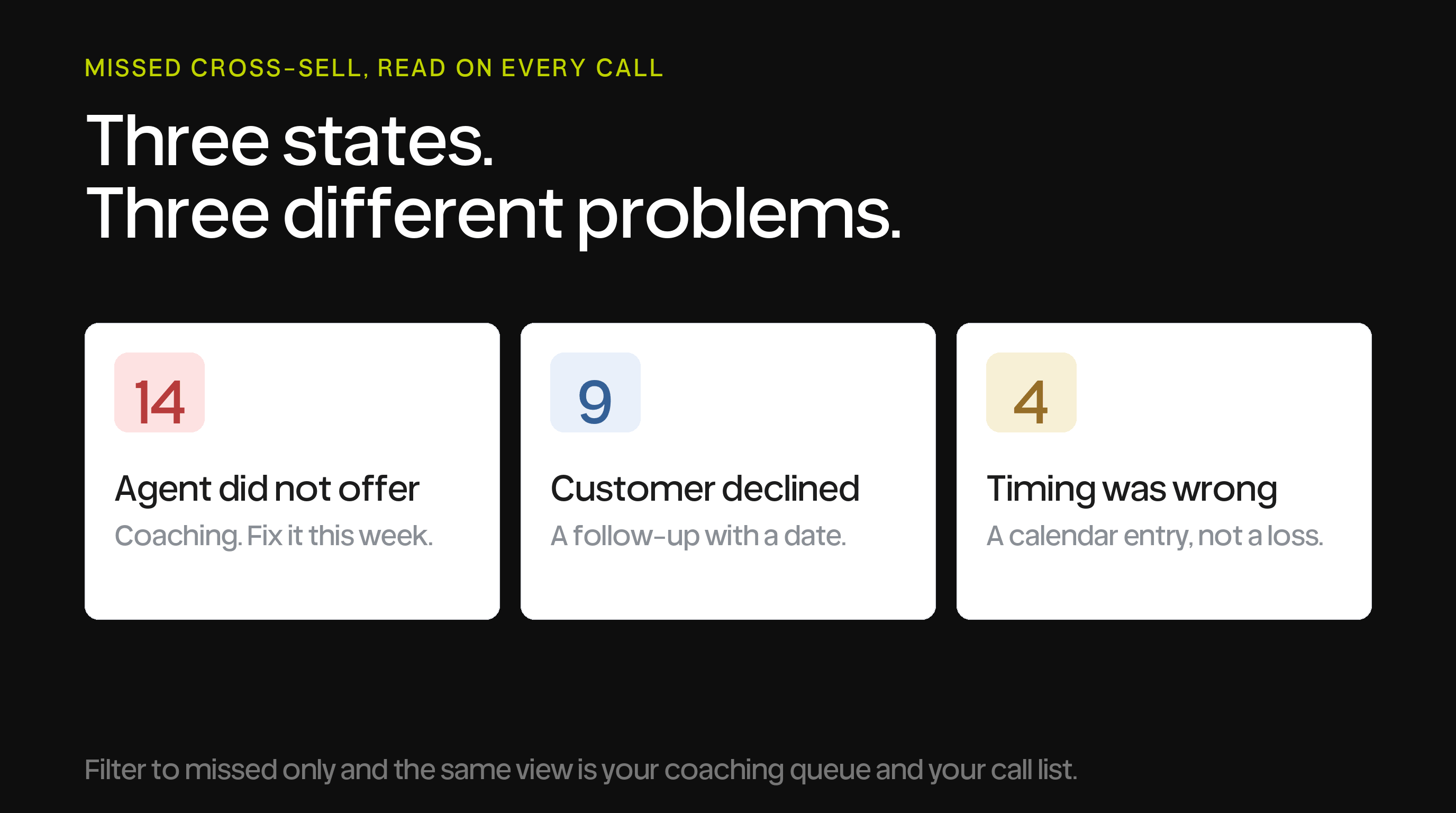
Filter to missed opportunities only, export the list, and you have both your coaching queue and your call list from the same view. A weekly digest of missed cross-sell, with the count and links straight into the calls, turns the invisible into a number a manager can actually work.
The same applies by carrier. Some carriers underwrite auto-to-home bundles well, others do not. Knowing which combinations have the highest bind probability is the kind of operational intelligence that compounds, and it changes who you quote first.
Shift 6: cross-sell during inbound calls, not just outbound
A meaningful share of cross-sell opportunities surface during inbound calls. A customer calls in about a claim, a coverage change, or a billing question. In the course of that conversation, an opportunity surfaces.
If your inbound coverage is voicemail or a generic answering service, those moments are lost. If your inbound coverage is an Inbound AI Agent that identifies the caller before the greeting, captures structured intent, and generates the follow-up task, you catch them.
This is one of the under-appreciated benefits of modern inbound infrastructure. It is not just about answering more calls. It is about turning every inbound conversation into a structured data point that the cross-sell motion can act on.
What the data says
According to a 2026 Big “I” consumer survey, 76% of consumers say they are likely to re-examine or adjust their coverage in the next 12 months. That intent exists. The question is whether your agency is in the conversation when they act on it.
87% of consumers say working with an agent is very or somewhat important. The relationship is valued. What customers want is for the agent to be the one driving the proactive conversation. They do not want to have to remember to call you.
The 2025 Best Practices Study by Big “I” and Reagan Consulting shows top-cohort agencies hitting 10.7% organic growth, with sales velocity sustained above the healthy 12 to 13% threshold. A meaningful share of that organic growth is built on cross-sell into the existing book, not entirely on new logo acquisition.
Read those three findings together and the conclusion is uncomfortable. Most of your customers intend to review their coverage this year, most of them want an agent involved, and most of them will do it with somebody else unless you book the conversation first.
%20(1).png?width=1920&height=1080&name=CTA%20(2)%20(1).png)
A 90-day cross-sell sprint
If you want to actually move the cross-sell number:
Days 1 to 15: pull the data. Run the AMS query. Identify your auto-only, home-only, and bundle-only segments. Look at the top 200 cross-sell candidates by lifetime value, sorted by tenure. Record today’s cross-sell rate before you change anything, because without a baseline you will not be able to prove what worked.
Days 15 to 30: train the conversation. Run a cross-sell training sprint for your producers. Simulation is the cheapest way to get the reps in. If you do not have a training tool, structured role-play with the sales manager works for a smaller team. Drill the four objections above until the responses are automatic.
Days 30 to 60: run a calendared cross-sell motion. Pick one cross-sell type. Auto-to-home is usually the easiest. Run a structured cadence against your top 200 candidates. Measure conversion by producer as you go, not at the end.
Days 60 to 90: read the results. Look at cross-sell rate by producer, by carrier, and by customer segment. Identify what worked and what did not. Plan the next sprint.
What to watch, weekly: cross-sell rate on the target segment, missed-opportunity count by producer, quotes issued versus policies bound, and average policies per household. That last one is the number that actually compounds, because it is retention and revenue in a single figure.
The agencies that move from a 20% cross-sell rate to a 35% cross-sell rate over a year do not do it through inspiration. They do it through structured sprints, repeated.
The mistakes that undo it
Three ways agencies sabotage their own cross-sell push, all of them common.
Running it as a campaign instead of a habit. A cross-sell month produces a spike and then a return to baseline. The number only moves permanently when the cadence is standing.
Leading with the discount. Bundle savings are a reason to say yes, not a reason to call. Lead with the review and the gap you found. Discount-led calls train customers to see you as a price channel, which is exactly the relationship you are trying to avoid.
Cross-selling the household you have not looked at. Nothing damages trust faster than pitching home insurance to someone who told your service team last month that they rent. Pull the record before the call. This is precisely why the trigger data has to live in a system rather than in someone’s head.
When you want to see what the infrastructure looks like
If you want to see trigger capture, cadenced outreach, missed-opportunity reporting, and cross-sell simulation working together, you can start a trial and see it against your own book. Or, if you want to read more on the retention motion side, our 10 retention strategies piece pairs well with this playbook.

.png?width=520&height=294&name=hf_20260904_130557_d687ffbb-70ec-45f1-a0d5-27346188edf0%20(1).png)
.png?width=520&height=294&name=hf_20260806_204231_f3f8ad5d-f30a-44bf-927d-2bfce7f4d6df%20(1).png)
Comments