.png?width=239&height=25&name=Logo%20horizontal%2001%20(1).png)
Alt text: A desk phone in an empty insurance agency at dusk
It is 5:01 PM on a Tuesday. A homeowner who just got a renewal increase from her current carrier searches "insurance agency near me," calls the first result, gets voicemail, and hangs up. She calls the second result. Someone answers. That agency now owns the quote, the bind, and probably the referral to her brother-in-law.
Nothing about that story is exotic. In a 2025 CallRail survey of 1,000 US consumers, 78% said they have abandoned a business after an unanswered call, and 82% said they will call a competitor if you do not answer. The missed call is the quietest leak in agency economics because nobody logs it: your AMS has no record of the customer you never met.
This article does two things. First, it puts numbers on the leak so you can size it for your own shop. Second, it compares the four honest ways to fix it: voicemail done well, a live answering service, hiring another CSR, and an AI receptionist. Each has a legitimate use case. Only one of them is free, and it is the one that loses the most business. One disclosure up front: SUPERAGENT builds an AI receptionist for insurance agencies, so we have a view on option four. We have tried to give every option a fair hearing, including the ones that are not ours.
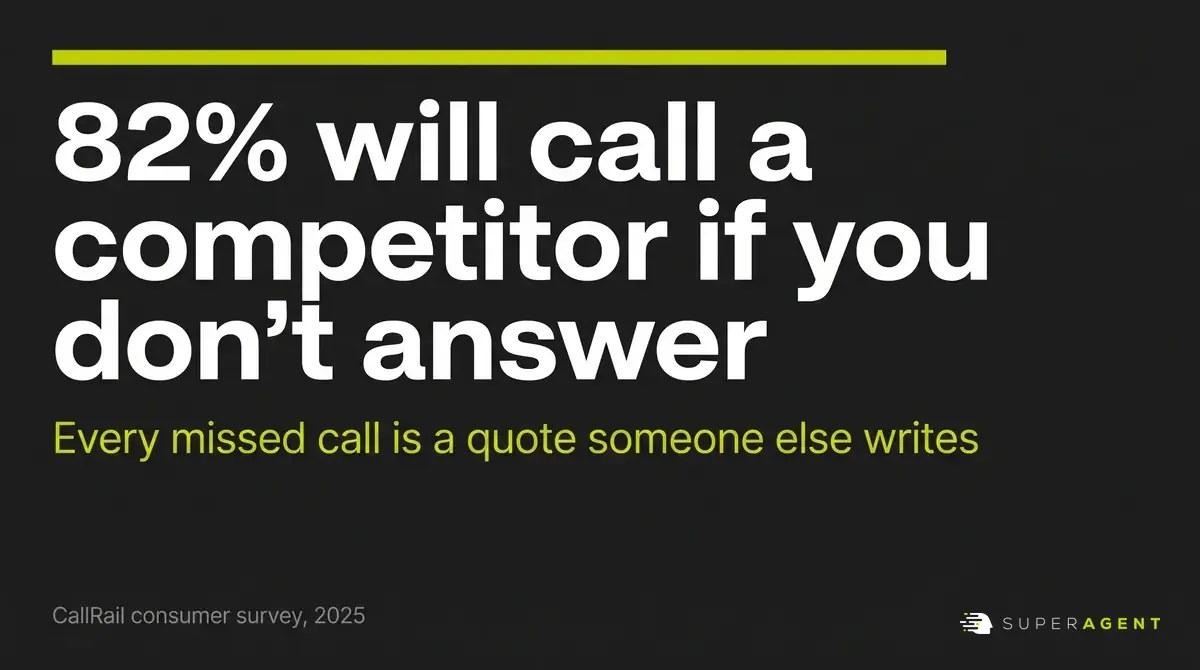
Alt text: Statistic card: 82% of consumers will call a competitor if you don't answer, CallRail consumer survey 2025
Sizing the leak: the missed-call math

Alt text: Section card: The missed-call math, size the leak with your own numbers
How many calls does a typical small business miss? More than most owners guess. A 411 Locals study that tracked 85 small businesses for 30 days found 62% of their calls went unanswered, and 70% of the businesses answered fewer than half of their incoming calls. It is an older and smaller study, so treat it as a warning rather than a benchmark. The right number is your own, and most phone systems can report it in minutes.
Here is a simple model you can run with your agency's figures. The values below are illustrative, deliberately conservative, and worth replacing with your actuals.
|
Input |
Illustrative value |
Your agency |
|---|---|---|
|
Inbound calls per month |
400 |
___ |
|
Share missed (after hours, lunch, overflow) |
25% (100 calls) |
___ |
|
Share of missed calls that are sales opportunities |
30% (30 calls) |
___ |
|
Callers who reach a competitor instead of trying again |
50% (15 lost prospects) |
___ |
|
Close rate on answered sales calls |
25% |
___ |
|
Policies lost per month |
about 4 |
___ |
|
First-year commission per household (illustrative) |
$250 |
___ |
|
Lost new business commission per year |
about $12,000 |
___ |
That is before retention math (multi-line households renew better), before lifetime value, and before the service side: a policyholder with a claim who reaches voicemail twice is a policyholder shopping at renewal.
The point of the model is not precision. It is that a 25% missed-call rate almost never shows up in any report an owner reads, while a $12,000 leak in ad spend would trigger a Monday meeting.
Option 1: Voicemail (the default that measures worst)
Alt text: Section card: Voicemail, the free default that measures worst, with an empty agency reception in warm afternoon light
Voicemail is free, which is why it guards the front door of most agencies after 5 PM. Its economics rest on one assumption: that callers leave messages and wait. Many do not. In the CallRail survey, only 42% said they leave a voicemail when a call goes unanswered, and 21% said they immediately contact a competitor. A prospect comparing agencies has zero switching cost at the beep; the next agency is one tap away.
Speed matters even when the caller does leave a message. Research published in Harvard Business Review found that firms contacting a lead within an hour were nearly seven times as likely to qualify it as firms that waited even one more hour. A voicemail left at 5:15 PM and returned at 9:30 AM is sixteen hours into that curve.
Where it is fine: True solo shops in low-competition markets, and as a fallback layer behind something better.
Where it fails: New business. The caller who most needs a live response, the shopper in motion, is exactly the caller least likely to leave a message.
Cost: $0 visible, highest invisible.
Option 2: A live answering service
Alt text: Section card: Live answering service, a person picks up and takes a message
A human answering service picks up around the clock and takes a message: caller name, number, reason. For overflow and after-hours coverage, it beats voicemail because the caller talks to a person, which keeps some shoppers from dialing the next agency immediately.
Its ceiling is insurance-specific knowledge. A generalist operator cannot qualify a P&C lead, cannot tell an X-date from a claim call, cannot book against your producers' real calendars, and typically will not log anything in your AMS. You get a message in the morning, and the speed-to-lead clock has been running all night.
Pricing is usually per minute of live receptionist time. As one published example, Ruby's virtual receptionist plans run from $250 a month for 50 minutes to $1,725 a month for 500 minutes (accessed September 2026). At the call volume in the model above, an agency would need custom pricing.
Where it is fine: Basic after-hours presence, claims-line reassurance, small service books.
Where it fails: Qualification, booking, and anything that requires knowing insurance.
Cost: Roughly $3.45 to $5.00 per receptionist minute on published plans; verify quotes for your volume.
Option 3: Hire another CSR

Alt text: Section card: Hire another CSR, great for complex service but bound to business hours
The traditional fix, and for many agencies still a right one: a good CSR compounds. But the arithmetic and the labor market both push back.
Start with cost. The US Bureau of Labor Statistics puts the mean annual wage for customer service representatives at insurance agencies and brokerages at $46,510 (May 2023 estimates). Benefits add roughly 30% of total employer compensation costs in private industry, per BLS, which puts a loaded CSR near $66,000 a year before software seats and training time. That buys coverage during business hours in one time zone.
Then add the hiring market. The industry has been warned for years that it could lose around 400,000 workers through attrition by 2026, citing BLS data, and hiring for after-hours coverage specifically means night and weekend shifts that most agency staff will not take.
The subtler issue is what the new hire spends their day on. If a meaningful share of their hours goes to answering overflow, taking messages, and re-keying data, you have paid a full salary for work that is largely triage.
Where it is right: Growth in complex service work, relationship depth, licensed work that requires a human.
Where it fails: 24/7 coverage economics, and triage work below a human's pay grade.
Cost: About $66,000 a year loaded, business hours only.
Option 4: An AI receptionist
Alt text: Section card: AI receptionist, answers on the first ring day or night
The newest option, and in 2026 a mainstream one for agency work: 65% of independent agents used AI at work in the past year, up from 37% the year before, per Liberty Mutual's Agent for the Future survey of 1,149 agency principals and staff. A modern insurance AI receptionist answers every call on the first ring, day, night, and weekends. The credible versions go well past message-taking: they qualify the caller conversationally against your agency's playbook, route service and claims calls to the right person, book qualified prospects directly onto producer calendars, send a confirmation text, and log the call in your AMS.
Two honest caveats. First, quality varies enormously; a bad AI receptionist is a phone tree with better marketing, so test it with your own calls before you buy. Second, an AI receptionist fixes answering and intake; it does not replace licensed advice, and the good vendors are explicit about where the handoff to a human happens. The same Liberty Mutual research found agencies are deliberately cautious here: about 26% said they would not consider AI for taking a customer's initial contact information. That caution is healthy. It is also exactly why the right test is your own callers, not a vendor demo.
Where it is right: After-hours and overflow coverage, speed to lead, consistent intake, agencies that cannot justify a night-shift hire.
Where it fails: Complex advisory conversations, which should be routed to producers anyway.
Cost: Insurance-native platforms publish plans from about $299 to $999 a month. SUPERAGENT's pricing, for example, includes 1,350 AI minutes on the $499 Pro plan, which works out to about 37 cents per included minute.
Side-by-side comparison
Alt text: Section card: Four options side by side, availability, qualification, booking, cost
|
Dimension |
Voicemail |
Answering service |
New CSR hire |
AI receptionist |
|---|---|---|---|---|
|
Availability |
24/7, passive |
24/7, live |
Business hours |
24/7, live |
|
Answers on first ring |
No |
Usually |
When free |
Yes |
|
Insurance qualification |
No |
No |
Yes |
Yes, per your playbook |
|
Books appointments |
No |
Rarely |
Yes |
Yes, onto real calendars |
|
Logs to AMS or CRM |
No |
Rarely |
Yes |
Yes (verify integrations) |
|
Speed to lead |
None |
Delayed (message relay) |
Good, hours-limited |
Seconds, any hour |
|
Consistency |
Not applicable |
Varies by operator |
Varies by day |
Same discipline every call |
|
Typical cost basis |
$0 |
About $3.45 to $5.00 per minute |
About $66,000 a year loaded |
About $299 to $999 a month |
|
Best use |
Fallback layer |
Basic presence |
Complex service and sales |
Coverage, intake, speed |
What to look for if you evaluate an AI receptionist
Alt text: Section card: Five things to check before you buy an AI receptionist
- Insurance fluency. It should qualify using your playbooks and understand LOBs, carriers, and renewal language without being taught what insurance is.
- Real calendar booking. Direct booking against Google, Outlook, Cal.com, or Calendly, not "we will email you a summary."
- AMS and phone system fit. Confirm named integrations for your stack, and how call notes land in your system of record.
- Warm handoff behavior. When a hot caller wants a human now, how does the transfer work, and what context does your producer get?
- A way to prove it. Month-to-month terms and a free trial mean you can forward your line for two weeks and judge it on your own calls.
Where SUPERAGENT fits
Alt text: SUPERAGENT closing card: The AI receptionist that never clocks out
SUPERAGENT's Inbound AI Agent is the insurance-native version of option four: the AI receptionist that never clocks out. It answers every call 24/7, qualifies callers conversationally on your agency's playbooks, routes service, claims, and billing calls to the right person, books qualified prospects directly onto producer calendars (Google, Outlook, Cal.com, or Calendly), and writes the activity back to your AMS. It goes live on your existing line by call forwarding, and it greets known callers by name when AgencyZoom or HawkSoft provides a match. When a caller needs a person, it warm-transfers with a quick briefing so your producer knows who is calling and why.
Suzanne Loehr, agency manager at Stieber Insurance, put it this way: "I was shocked at how real it sounds. It handles the conversation, gets their information, and books the appointment. I don't have to worry about missing calls anymore."
If missed calls are the leak you want to close first, forward your line and judge it on your own calls. Start your 14-day free trial at getsuperagent.com. No commitment required, cancel anytime.
Frequently asked questions
How many calls do insurance agencies actually miss?
It varies widely by staffing and hours, which is why the only reliable number is your own. As a reference point, a 411 Locals study of 85 small businesses found 62% of calls went unanswered. Because many unanswered callers never leave a message, most agencies have no record of the volume until they pull a missed-call report from their phone system.
What happens when a prospect's call goes unanswered?
Often, they call someone else. In CallRail's 2025 survey of 1,000 US consumers, 82% said they will call a competitor if a business does not answer, and only 42% said they leave a voicemail. For an agency, that competitor is usually the next result in the same search.
Is an answering service worth it for an insurance agency?
It is better than voicemail for basic after-hours presence, since callers reach a live person. Its limit is insurance capability: generalist operators cannot qualify leads, book against producer calendars, or log calls to your AMS, so sales opportunities still wait until morning. Published plans typically price by the receptionist minute.
What does an AI receptionist for an insurance agency cost?
Insurance-native platforms publish plans from roughly $299 to $999 a month depending on volume and features. Compare that to a loaded CSR near $66,000 a year for business-hours coverage, and to the new business value of the calls currently going unanswered.
Will callers accept talking to an AI?
When the AI is good, most callers care that someone answered and got them what they wanted: a booked appointment or a routed claim call. Agencies are right to be cautious about intake quality, which is why the best test is to forward your line during a trial and listen to real calls before you commit.

%20(1).png?width=520&height=294&name=hf_20260618_105923_d7713a70-37c9-4b0e-9977-43dda985a28a%20(1)%20(1).png)
.png?width=520&height=294&name=hf_20260529_164843_191516b1-be0c-4714-8879-a42c3a7183b0%20(1).png)
Comments