.png?width=239&height=25&name=Logo%20horizontal%2001%20(1).png)
Building a sustainable insurance agency isn't about winning new customers.
It's about keeping the ones you have and expanding your relationship with them year over year. Yet most agencies focus 80% of their efforts on new business (quoting, prospecting, closing) and 20% on retention.
This is backwards. Retaining an existing customer costs 1/7th the cost of acquiring a new one, and existing customers generate 3-5x higher lifetime value.
The challenge is that retention isn't flashy. It doesn't create immediate revenue spikes like a big new client win. It compounds quietly over years.
An agency that improves retention from 84% (industry average) to 93% (best-in-class) doesn't see a dramatic revenue jump immediately.
But over 3-5 years, that 9-point improvement in retention multiplies across the entire book and creates $500K+ in incremental revenue from the same customer base.
Here are the 10 most proven strategies for protecting and growing your book of business through retention.
1. Conduct Annual Coverage Reviews to Catch Underinsured Segments
Most customers are systematically underinsured. They have basic coverage but lack protection for emerging risks. Annual coverage reviews catch these gaps before claims expose them.
Schedule a 30-minute conversation annually with each customer.
Walk through their life and business: What's changed? New employees? New assets? Expanded locations? Increased revenue? Different risk profile?
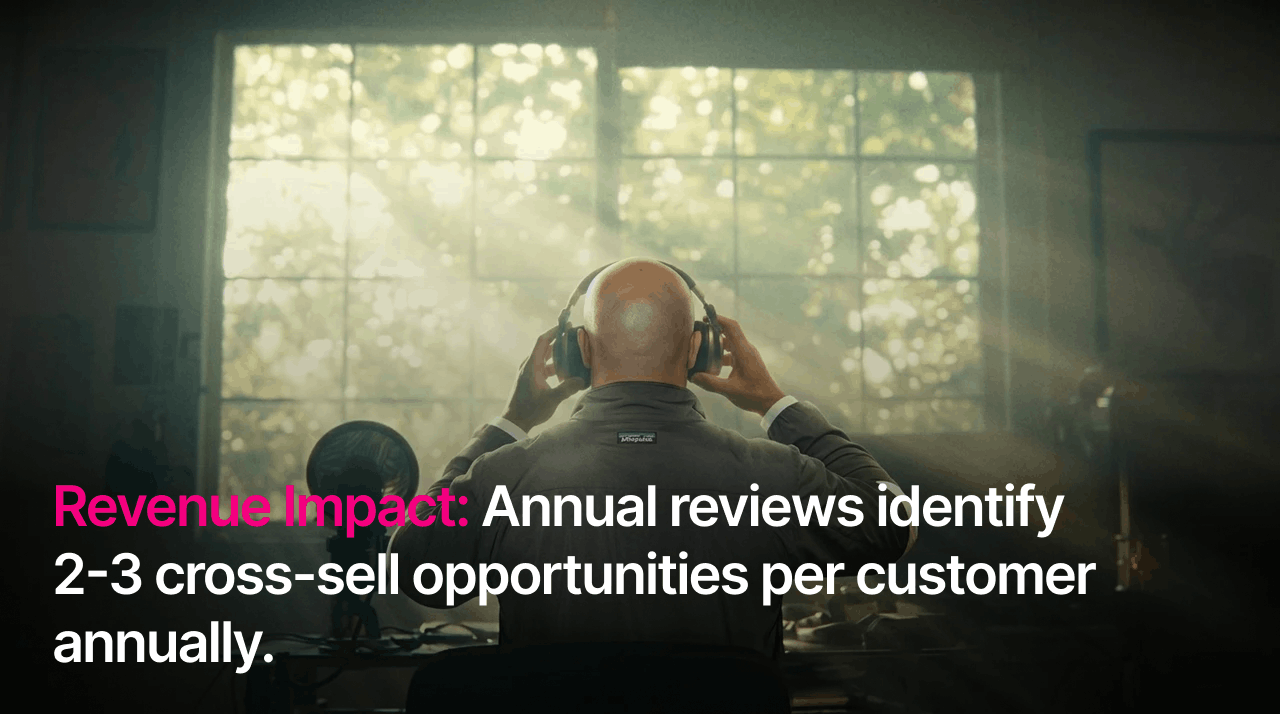
This conversation surfaces coverage gaps (missing umbrella, underinsured liability limits, inadequate property coverage) and creates cross-sell opportunities. Annual reviews drive policy expansion and churn reduction simultaneously.
2. Engage Proactively at Life Milestones
Life changes create coverage needs.
When a customer gets promoted, relocates, has a child, starts a business, or experiences major life events, their insurance needs change.
Agencies that reach out proactively at these moments strengthen relationships and prevent churn.
Build a milestone engagement system.
Trigger list: promotions, relocations, marriage, divorce, births, empty nest, business milestones, major purchases.
When you detect (or customer mentions) a milestone, schedule a coverage review within 48 hours.
"I saw you were promoted, congratulations! Let's make sure your coverage still matches your new life situation."
This feels like relationship care, not a sales call. It prevents the coverage gap from becoming a reason to leave.
3. Optimize Claims Experience Speed and Communication
Claims are make-or-break moments for customer satisfaction and retention.
A 15% reduction in claims cycle time drives approximately 25% increase in renewal rates.
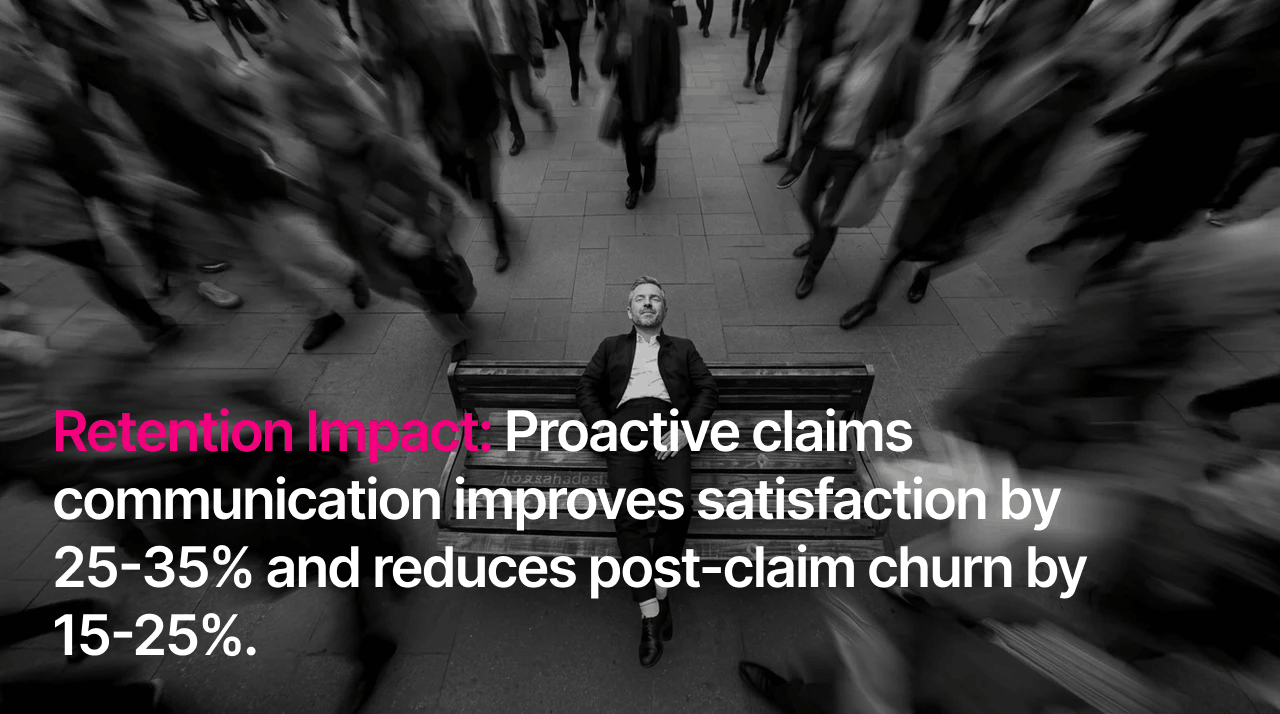
Set up proactive claims communication. When a claim is filed, contact the customer within 24 hours with status and timeline. During the claims process, send weekly updates.
Don't wait for the customer to call asking 'where's my claim?' Instead, call them: 'Here's where we are, here's what to expect next.' When claims close, ask for feedback: 'How was your experience? Anything we can improve?'
This demonstrates that the agency cares about claims experience, not just premium collection.
4. Expand Policies Per Customer to Deepen Relationship Lock-In
The most reliable retention metric is policies per customer.
A customer with one policy churns at 15% annually. A customer with 1.8+ policies churns at 5% annually.
Every additional policy adds friction to switching because leaving means losing multiple relationships.
Systematically pursue cross-sell expansion. If a customer has auto, sell home. If they have business auto, sell commercial property, liability, workers' comp. If they have commercial, sell personal umbrella. Map out the logical policy progression for each customer type.
Track cross-sell penetration by customer segment. Hold producers accountable for increasing policies per customer, not just revenue. When you increase average policies per customer from 1.2 to 1.8, you reduce annual churn from 15% to 5%—a 67% reduction.
1.8+ average policies per customer needed for 5% annual churn (vs 15% for 1.2 policies)
5. Implement Competitive Quote Response Protocols
When a customer asks for a competitor quote, they're not shopping, they're checking if you're priced competitively.
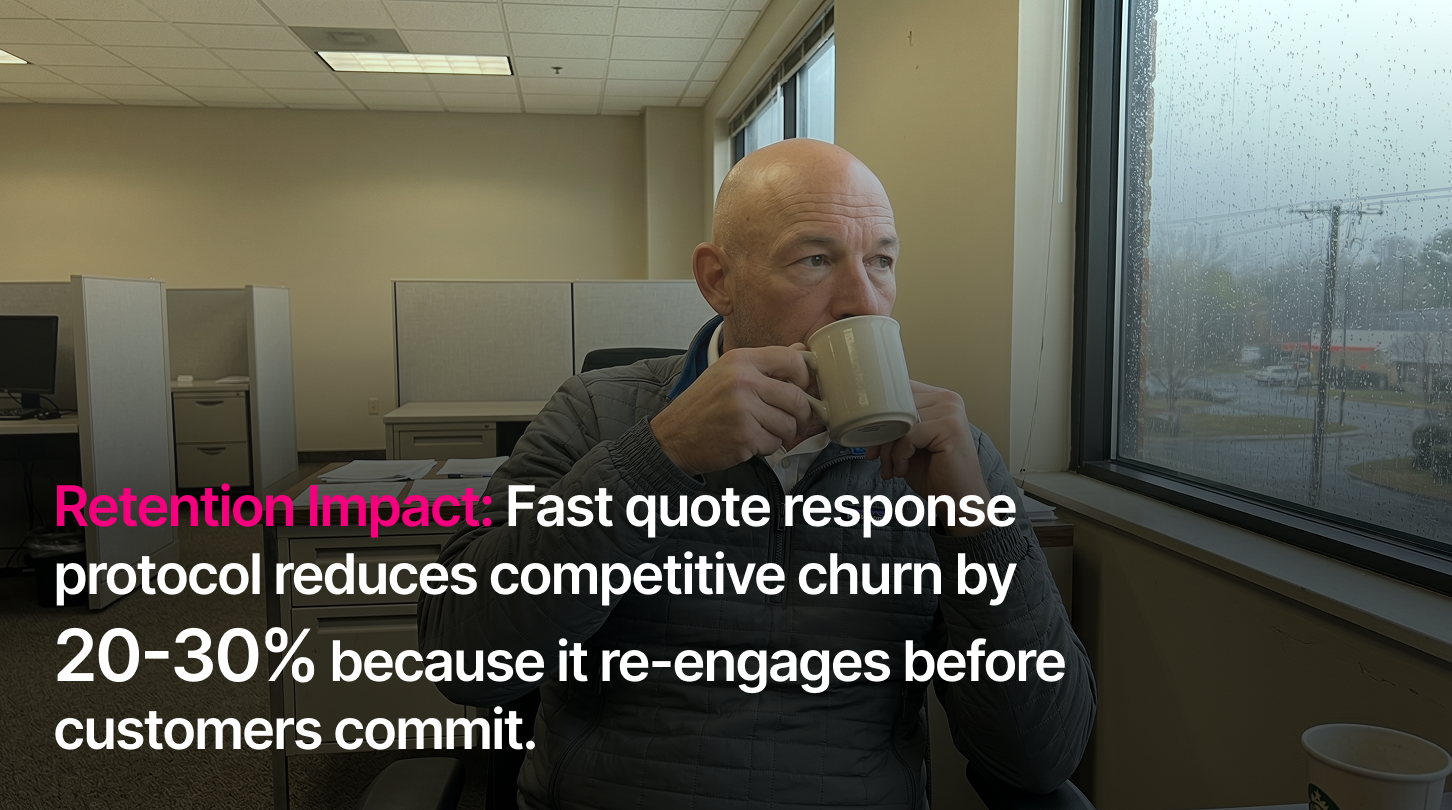
This is a visible churn signal. If you ignore it, the customer assumes you're overpriced and leaves. If you respond with competitive quotes and value-based alternatives, you re-engage before they commit to switching.
Create a protocol for quote requests. When a customer asks for quotes, respond within 4 hours (not 2 days).
Provide your own quotes plus value-based alternatives: 'Here's what you'd pay elsewhere, but here's the value you'd lose with us (better service, faster claims, more comprehensive coverage, 10-year relationship).'
Show the true cost of switching, not just premium. This prevents the competitor from anchoring the customer before you've had a chance to make your case.
6. Systematically Monitor Customer Satisfaction and Sentiment
Dissatisfied customers don't call to complain. They quietly leave.
The only way to catch dissatisfaction early is to measure it systematically. Deploy regular satisfaction surveys, NPS (Net Promoter Score) tracking, and sentiment analysis to identify at-risk customers before they leave.
Set a cadence: NPS survey annually or bi-annually. Track trends over time. When you see declining satisfaction scores, reach out personally. 'I noticed your satisfaction score was lower this quarter—what's not working?' This proactive problem-solving prevents silent churn because you catch issues before customers decide to leave. Best-in-class agencies achieve NPS of 60+. Average agencies hover at 30-40. That 20-30 point gap directly correlates to retention difference.
7. Create VIP Loyalty Programs for Top Accounts
Your best customers deserve premium treatment.
Creating a VIP segment of top accounts and treating them differently (faster service, exclusive rates, priority support) strengthens relationships and reduces churn among your highest-value customers.
Identify your top 20% of accounts by lifetime value. Segment them as VIP. Assign dedicated account managers for top accounts.
Offer VIP-exclusive benefits: priority quote turnaround, loyalty discounts, annual VIP dinners, early access to new products.
Make these customers feel valued, not transactional. The investment in VIP treatment pays for itself through higher retention of your most profitable accounts.
8. Offer Value-Added Services Beyond Insurance
Insurance is commoditized. Agencies that only offer insurance commodities compete purely on price.
Agencies that offer value-added services (risk management resources, business continuity planning, HR support for business clients) build stickier relationships that aren't price-sensitive.
Examples: host quarterly webinars on risk management, provide HR compliance resources for business clients, offer free loss control assessments, host educational seminars on insurance basics for personal clients.
These services create value beyond insurance, build deeper relationships, and give customers reasons to stay beyond price.
9. Use Predictive Analytics to Identify Churn Risk
Churn isn't random. Certain customer signals predict higher churn risk: declining engagement, multiple quote requests, claims dissatisfaction, policy gaps. Predictive analytics tools can flag high-risk customers before they leave, giving you time to re-engage.
Implement a churn risk model. Score all customers monthly based on engagement, satisfaction, quote requests, and behavioral signals. When a customer scores high-risk, trigger a re-engagement protocol.
A personal call from the agent or manager, not an automated email. 'I saw it's been 6 months since we talked—wanted to check in. Anything changing in your life I should know about?'
This personal outreach prevents silent churn because it re-engages before customers have decided to leave.
10. Automate Proactive Engagement Campaigns for At-Risk Segments
Systematic proactive engagement doesn't scale with manual phone calls.
Agencies managing 1,000+ customers can't personally call every customer for milestone engagement, satisfaction checks, or re-engagement campaigns. Automation is essential.
Use AI-powered systems that identify engagement opportunities automatically and route them to producers for action.
When the system detects a life change from a call, it alerts the producer: 'Customer mentioned relocation during call: trigger coverage review.'
When a customer hasn't been contacted in 90 days, it flags them: 'At-risk for engagement decay: schedule check-in.
' When NPS scores drop, it alerts management: 'Customer satisfaction declining: reach out personally.'
Automation enables systematic proactive engagement that would be impossible manually.
Retention Impact: Automated engagement systems increase contact frequency with customers by 3-5x (from 2-3 contacts annually to 8-15 contacts). This alone improves retention by 15-25%.
5% increase in retention = 25-95% increase in profit (compounding over time)
Putting It All Together: The Retention Transformation
Individually, each strategy improves retention by 5-25%. Combined, these 10 strategies can transform retention from 84% (industry average) to 93%+ (best-in-class).
For a 1,000-customer book with $1,200 average annual commission per customer, that improvement represents $108,000+ in recovered revenue annually, plus compounding benefits over years.
The key is implementation.
Strategies work only when they become systematic and accountable.
Assign ownership for each strategy. Track metrics. Hold teams accountable for execution.
A 9-point retention improvement doesn't happen by accident. It happens through disciplined, systematic execution of these 10 tactics.
Start with the 2-3 strategies that address your highest leakage points. If you're losing customers to price, prioritize competitive quote response protocols. I
f you're losing customers to coverage issues, prioritize annual reviews and cross-sell expansion.
If you're losing customers silently (you don't know why), prioritize satisfaction monitoring and churn risk analytics. Build from your highest-impact opportunities.
Retention is the highest-ROI business activity in insurance. A single 5% improvement in retention can increase profits by 25-95% because it compounds across the entire book over years.
The agencies winning today aren't those winning the most new business. They're those best at keeping what they have and expanding relationships with their existing customers.
How SUPERAGENT's Retention AI Agent Solves This
SUPERAGENT's Retention AI Agent automates all 10 of these retention strategies simultaneously. It conducts automated coverage analysis for gaps, identifies life changes from calls, monitors satisfaction signals, flags churn risk, and systematically triggers proactive re-engagement at exactly the right moments.
The agent handles everything from milestone engagement to cross-sell detection to at-risk customer interventions, all automatically, all at scale.
- Annual Coverage Review Automation (Tactic #1): AI analyzes customer profiles, identifies gaps automatically, recommends specific coverage additions.
- Life Milestone Engagement (Tactic #2): Detects life changes from calls, schedules proactive coverage reviews automatically.
- Claims Experience Monitoring (Tactic #3): Tracks claims sentiment, identifies dissatisfaction early, triggers proactive follow-up.
- Cross-Sell Detection & Expansion (Tactic #4): Identifies customers missing key policies, recommends logical next products automatically.
- Churn Risk Analytics (Tactic #9): Scores all customers for churn risk monthly, flags high-risk accounts for intervention.
Results agencies are seeing:
- 35% improvement in overall retention rates (84% → 93%+)
- 40% increase in cross-sell opportunities identified
- 67% reduction in churn for customers with 1.8+ policies
- $108K+ annual revenue recovery per 1,000-customer book
- 8-25% improvement per strategy, 50%+ combined improvement
- 9-point retention improvement = $500K+ incremental lifetime value
Automate all 10 retention strategies. Stop managing engagement manually.

%20(1).png?width=520&height=294&name=hf_20260618_105923_d7713a70-37c9-4b0e-9977-43dda985a28a%20(1)%20(1).png)
.png?width=520&height=294&name=hf_20260529_164843_191516b1-be0c-4714-8879-a42c3a7183b0%20(1).png)
.png?width=520&height=294&name=hf_20260514_203535_fe46ef0c-e635-4559-98d1-2214b14d77d0%20(1).png)
Comments